Fusion Consulting
- Role
- Head of Marketing, then Product Manager for the practice once the first client engagement landed
- Client
- Fusion Consulting (Auston, Founder + Lead Consultant)
- Year
- 2026
- Status
- Live at consulting.tryfusion.ai
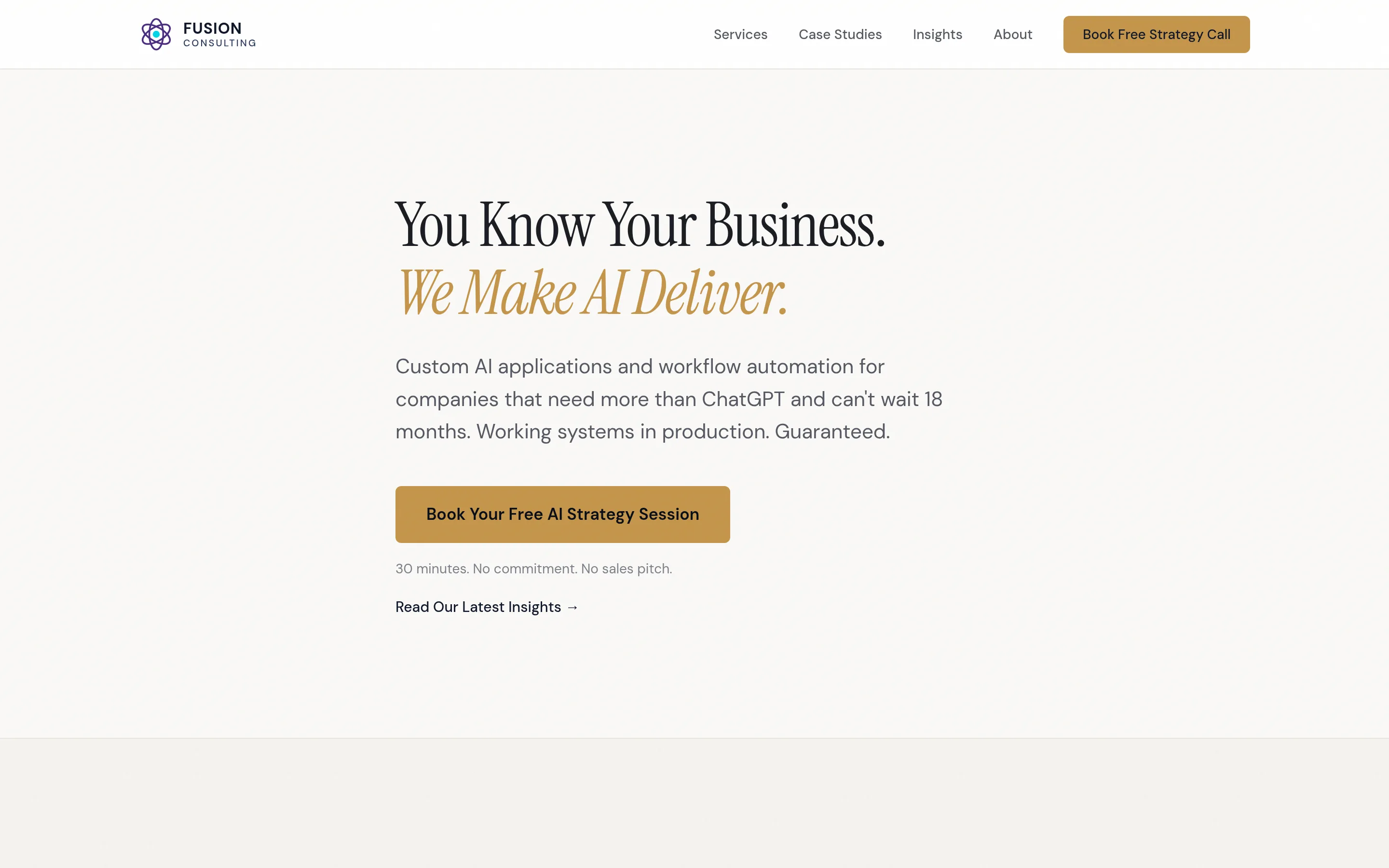
The live site at consulting.tryfusion.ai.
Result
This practice exists because I kept pulling on a thread nobody else was acting on. A prospect had once mentioned that the real need was consulting, not the platform, and the comment sat unused while we kept selling Fusion Business. When that proved a hard sell into buyers who often lacked the in-house AI talent to adopt the platform themselves, I revived the idea and pushed to actually investigate it. Auston agreed, and I led the research. The value was the specificity. The underserved gap was the mid-market, and a handful of regulated industries in particular. That finding became the practice. I built its go-to-market, wrote the 12-article insight portfolio and the ICP, and moved into product management for it when the first client engagement landed.
Problem
Fusion Consulting is an AI consulting practice for mid-market firms ($10M to $500M revenue). The gap it addresses is real. Big consultancies are too expensive, off-the-shelf tools are insufficient, and most mid-market companies lack the in-house AI expertise to bridge that themselves.
The constraint. Publishing into a regulated-industry-adjacent space requires source-verifiable claims, because a single misattribution is fatal to consultancy credibility. Twelve articles is a large surface to hold to that standard, and the verification had to catch errors introduced during editing, not just by the original author.
My Role
Finding the gap. The consulting direction began as an offhand comment from a prospect, that the real need was consulting rather than the platform. It sat unused while we kept selling Fusion Business. When that proved a hard sell, into buyers who often lacked the in-house AI talent to adopt the platform themselves, I brought the idea back and pushed to investigate it. Auston agreed, and I led the research. The value was in the specificity. The underserved gap was the mid-market, $10M to $500M firms too small for big-consultancy fees and too complex for off-the-shelf tools, concentrated in a few regulated industries. That specific finding became the practice's positioning.
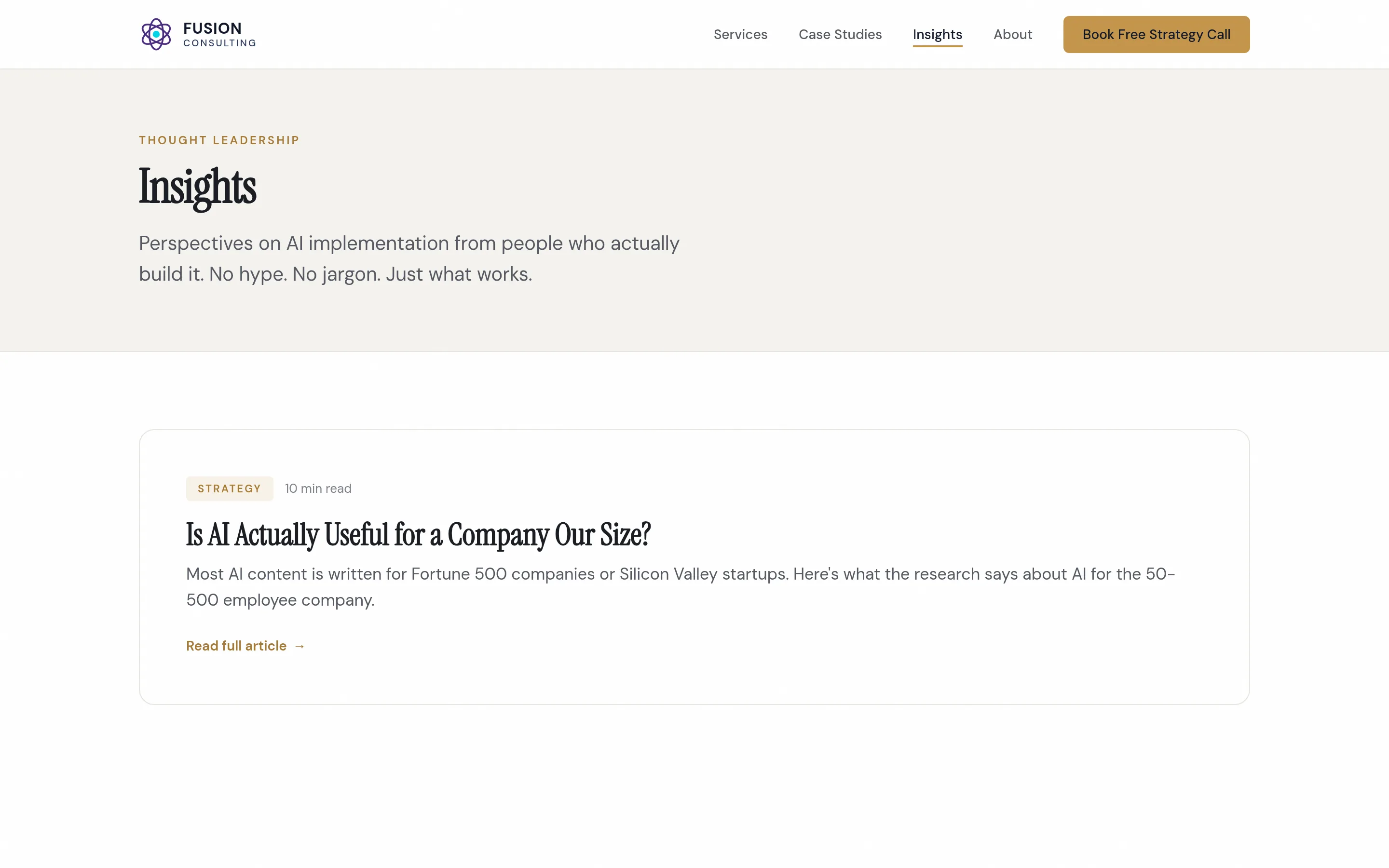
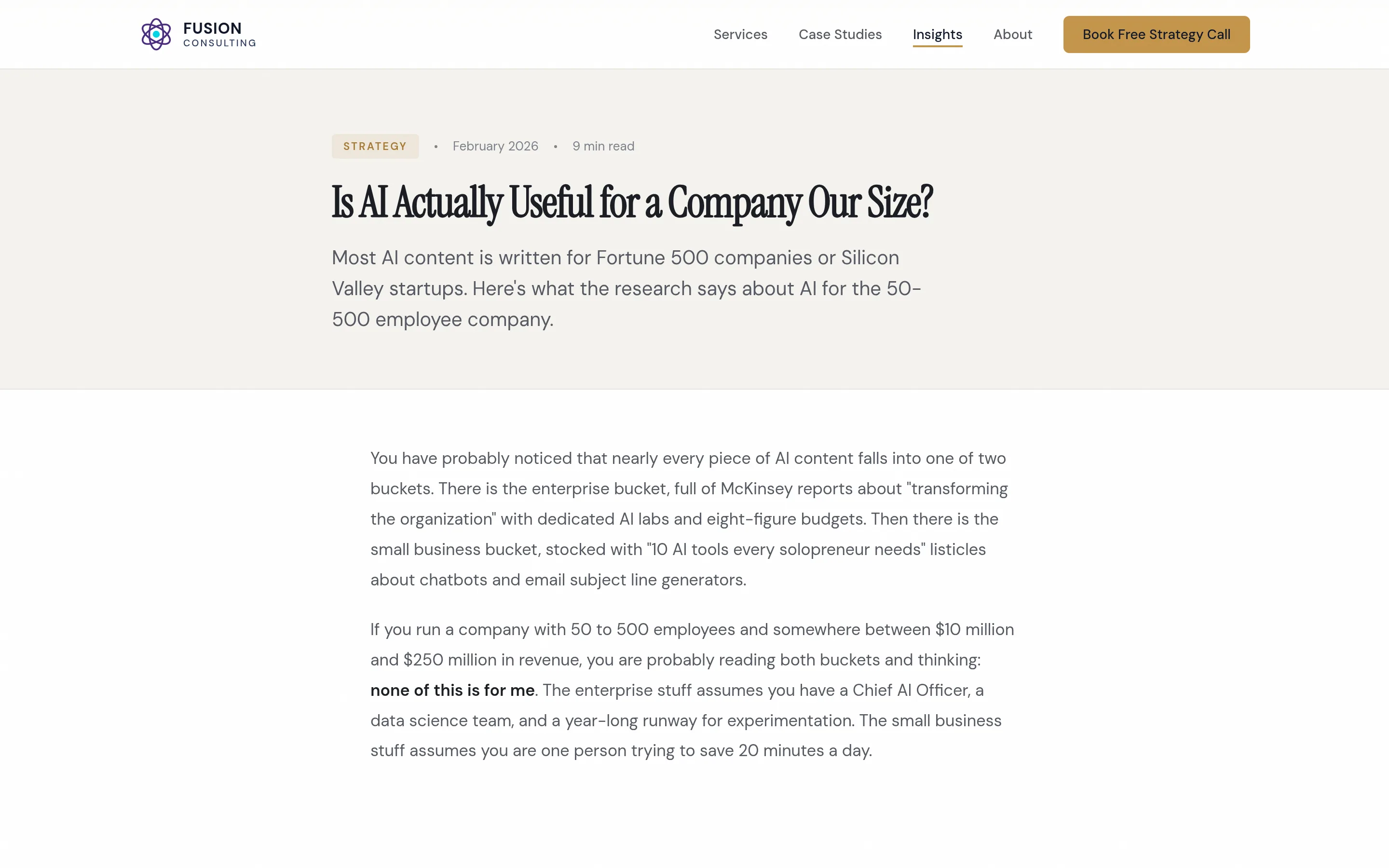
Authored the 12-article insight portfolio as the sole editorial voice, covering the mid-market AI gap, why AI projects fail, build versus buy, hire versus outsource, ROI and cost, governance, shadow AI risk, and AI in 30 days.
Designed and built the insights page, the public entry point to the portfolio.
Designed and then killed the scorecard lead-magnet, an interactive 12-question assessment with a scoring engine and email gate. On revisiting it after the build, I called it out as not backed by data and as scope creep, and killed the feature rather than ship something that would not hold up.
Authored the ICP, the ideal customer profile, defining the mid-market AI-consulting buyer, mapping industries by consulting fit, and identifying PE portfolio companies as the high-value segment. I wrote the enterprise platform's ICP too, which is how the two stayed distinct.
Ran the citation audit across all 12 articles, tracking 71 issues and catching 2 errors that editing had introduced. Authored the per-claim audit trail mapping every passage to a verifiable source URL.
Editorial review across the site's case-study pages, holding them to the same source-verification standard as the articles.
Solution and Process
The editorial approach was twofold, marketing copy carrying the product offer and thought leadership carrying the expertise behind it. Both were published on the same site and promoted through the same channels, so a buyer could find the thinking without hunting for it.
Verification was a post-write audit rather than a simultaneous one, which is the gap I would close next time. What did work was checking published claims against the source documents independently instead of trusting the writer's recall. That is what caught a Shadow AI statistic where both the unit and the frequency had drifted from the original.
Alternative considered and rejected. The scorecard lead-magnet. Interactive assessments are a standard consulting lead-gen pattern, but nothing empirical justified this one's scoring logic. Killing it was the correct call under the same standard that governed the articles.
Impact and Metrics
Live brand at consulting.tryfusion.ai with 12 source-verified articles as the content surface. Every claim traces to a verifiable source, drawing on primary publications from RSM, BCG, McKinsey, RAND, MIT, Deloitte, IDC, the U.S. Chamber, SBA, Vistage, Microsoft, and Intuit.
The audit caught two errors that would otherwise have shipped.
The ICP separated the consulting buyer (CEO, CTO, or VP at a $10M to $200M company with a failed AI pilot and board pressure) from the enterprise platform buyer, which stopped the two practices from blurring their messaging.
Reflection
I would move citation verification earlier in the production cycle instead of treating it as a post-write audit. Independent checking worked, but running it as a pre-publish gate would have caught the same errors before they propagated into related articles, which is what ate part of the production runway. The larger lesson is about where the signal was. The pivot did not come from the pipeline or the analytics. It came from standing in a room asking questions and being willing to hear that the thing we were selling was not the thing they wanted.
Start a conversation
Want to work together?
I'm looking for my next product management role. I've led as the only product person, and I've worked inside larger teams, and I'm glad to do either. What matters to me is shipping things that count, with people I can learn from.